
The answer is not in a bottle or in a substance – addiction begins on the inside. It starts in the mind.
Start with a thought. An emotion when it grows so heavy that it’s hard to bear. A bad habit that gets away from you. It’s controlling all those things, before anybody ever realizes.
For that reason, addiction treatment cannot be merely about quitting drugs and alcohol. Changing behavior is about changing the thinking and/or patterns that got them there in the first place.
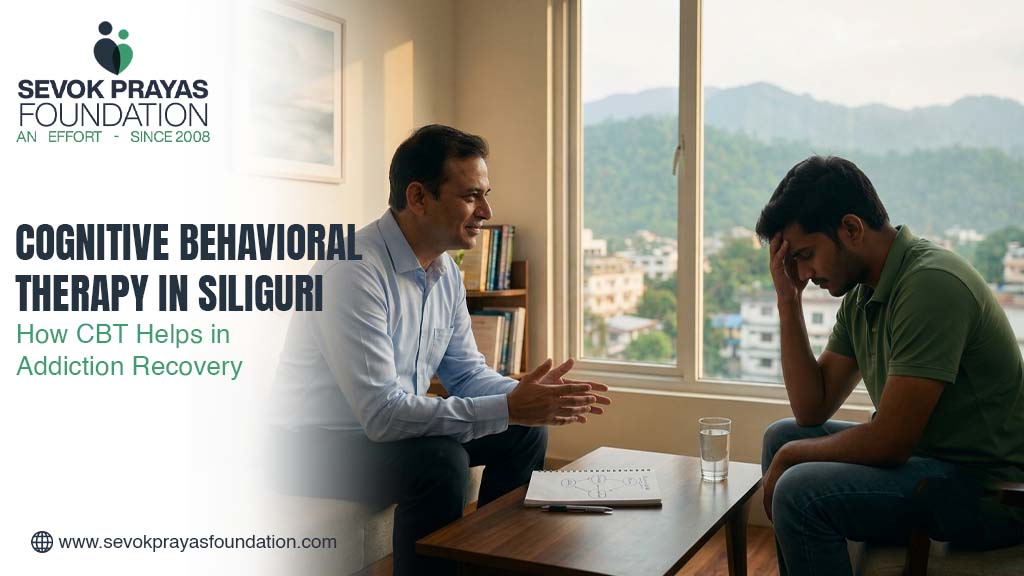
That’s exactly what the Cognitive Behavioural Therapy in Siliguri does and that’s why it’s one of the most powerful tools in addiction recovery, today.
What is Cognitive Behaviour Therapy (CBT)?
CBT is a type of talk therapy that’s structured. It’s practical. It’s goal-focused. And it works.
CBT is based on the interconnections between thoughts, feelings and behaviours. The principle behind the brain training program is that if negative thought patterns can be identified, then behaviours and emotions can be changed.
What you think and what you feel. How you feel influences how you behave.
Types of Cognitive Behavioural Therapy
Cognitive Behavioural Therapy comes in several specialised forms, each designed to address specific mental health and behavioural challenges:
- Rational Emotive Behaviour Therapy (REBT) – Focuses on identifying and challenging irrational beliefs that drive negative emotions and behaviours
- Dialectical Behaviour Therapy (DBT) – Combines CBT techniques with mindfulness and emotional regulation skills, especially helpful for intense emotions
- Acceptance and Commitment Therapy (ACT) – Helps individuals accept difficult thoughts rather than fighting them and commit to positive behavioural changes
- Mindfulness-Based Cognitive Therapy (MBCT) – Blends traditional CBT with mindfulness practices, particularly effective for preventing depression relapse
- TF-CBT (Trauma Focused CBT) – Designed specifically to help individuals who have suffered trauma/PTSD
- ERP (Exposure Response Prevention) – Typically used for obsessive compulsive disorder, through exposure therapy where one is slowly exposed to their fears without reacting
- CBT-A (CBT for addiction) – Done both individually and group based therapy, focusing on trigger identification, breaking the cycle of cravings and developing coping mechanisms
What CBT Counselling Actually Looks Like
Therapy at a rehabilitation centre can feel intimidating for many people at first, and that is completely normal.
A typical CBT counselling session by a professional centre includes the following:
- Individual 1-to-1 counselling with a trained counsellor.
- Recognising particular patterns of thinking and feelings that trigger them
- The art of ‘time out’ in the face of unhelpful thoughts
- A simple exercise, such as a thought journal or behaviour tracking.
- Discuss as a group; share experiences and support each other
- Weekly progress monitoring and coping strategies
It’s not intimidating. It is a confidential conversation, guided by a professional – that’s it.
Why is CBT Different from Other Therapies?
Most people believe therapy involves sitting, talking and crying for hours and hours. CBT is different.
- It’s practical rather than talkative – you aren’t sitting around talking, you’re learning new skills
- It is a short-term and focused – micro – based intervention with clearly defined goals within individual sessions
- It focuses on the present – not just what happened, but how to move forward
- It is proof based, based on clinical studies conducted over many years.
- Can be done on an individual or in group basis
CBT has been proven to cut in half relapse rates in addiction recovery by up to 60% according to SAMHSA (Substance Abuse and Mental Health Services Administration).
That’s a lot. That is indeed a changed life.
How CBT Helps in Addiction Recovery -Step by Step
The step-by-step approach to understanding how CBT can help heal your addiction
CBT assists people in recognising leftover thinking styles, cultivating coping mechanisms, and staying away from relapse. Now, much like any recovery journey…
Step | What Happens in CBT |
1. Identify Triggers | Identify the triggers for cravings such as places, people, circumstances and emotions |
2. Challenge Negative Thoughts | Question negative and irrational beliefs, such as: “I can’t cope without it.” |
3. Build Coping Skills | Discover coping skills for handling stress, cravings and challenging feelings. |
4. Practice New Behaviours | Replace unhealthy, unhelpful behaviours with healthier, helpful ones |
5. Prevent Relapse | Build a clear plan to handle setbacks without going back to substance use |
The process is structured. It’s done with a trained counsellor. And it works – session by session, step by step.
What CBT Treats at a Rehabilitation Centre
Behavioural counselling through CBT is effective for a wide range of addiction and mental health challenges:
Condition | How CBT Helps |
Alcohol addiction | Identifies drinking triggers and builds refusal skills |
Drug addiction | Addresses emotional pain behind substance use |
Brown sugar/opioid dependency | Breaks the automatic craving-response cycle |
Anxiety & depression (co-occurring) | Challenges negative thinking patterns |
Stress and emotional dysregulation | Teaches healthy coping strategies |
Relapse prevention | Builds a personalised plan for high-risk situations |
Alongside addiction, CBT also treats co-occurring disorders – helping people address both the addiction and the underlying mental health challenges at the same time.
Sevok Prayas Foundation -Siliguri's Trusted Home for Recovery
There is no destination in recovery. That’s a choice that every day, every minute, everyone has to make.
For that judgment to be made, there has to be the proper support around.
Founded in 2008, Sevok Prayas Foundation is one of the most well-known drug and alcohol rehabilitation centres in the region of Siliguri, West Bengal, focused on rehabilitation for addictions to alcohol and drugs. This is a 25-bed centre with the ambition to offer extensive care, from the 10 beds formed on the onset.
Why Choose Sevok Prayas Foundation?
What Matters | What Sevok Prayas Brings |
Experienced | Established in 2008 – 15 + years of hard-struggling recovery efforts. |
CBT & Behavioural Counselling | Individual and group structured CBT sessions |
Holistic Approach | This includes a 12-step programme, some yoga, meditation and medical help. |
Expert Team | Skilled counsellors, healthcare providers and psychiatric support personnel are available |
Residential Care | 25 bed facility with both AC and non-AC rooms along with indoor as well as outdoor activities. |
International Reputation | Families have trusted Sevok Prayas from India, Nepal, Bhutan & Bangladesh |
Family-Like Environment | Staff who care deeply — every resident is treated with dignity and respect |
Aftercare & Relapse Prevention | A helpful plan for post-treatment support of addiction |
Frequently Asked Questions (FAQs)
Q1. What is Cognitive Behavioural Therapy (CBT)?
Q2. Does Sevok Prayas Foundation provide CBT in Siliguri?
Q3. How long does CBT therapy take to show results?
Q4. Can CBT be used to treat addiction to alcohol and drugs?
Recovery Is Possible. It Starts with One Call
You need not go through this on your own.
Whether it’s for yourself or someone you love – reaching out is the bravest thing you can do. It can revolutionise everything.
Since 2008, it has been a turning point for hundreds of families at Sevok Prayas Foundation. Let it be yours.
Reach Out to Sevok Prayas Foundation Today.
Sevok Prayas Foundation – Return to a Fresh Start.